As the workforce supporting social infrastructure continues to decline, the number of aging facilities continues to grow. With it becoming increasingly difficult to inspect and repair every asset at the same frequency, what is needed is the ability to identify high-risk locations and direct limited resources toward the measures that will have the greatest impact. Conventional AI, however, struggles to predict situations that fall outside previously observed patterns, and its decision-making process is often a black box. This has made it difficult to use AI outputs as a basis for measures involving public funds. xCausal® offers a new approach by enabling decisions based on the cause-and-effect relationships that lead to deterioration and failure.
■ Challenges Facing Social Infrastructure
In Japan, the working-age population is declining and shortages of engineers are becoming more serious. At the same time, a growing number of social infrastructure facilities—including sewerage systems—are exceeding their expected service life. In other words, the workforce is shrinking while the number of assets requiring attention continues to grow. Facility renewal and maintenance also require substantial investment. Stagnating user-fee and tax revenues due to population decline, combined with rising prices and higher material and labor costs, mean that not every necessary measure can be implemented at once. That is why decisions such as “Where should we inspect first?”, “Which assets should we repair?”, and “Which measures should we choose?” must be made based on clear evidence.
■ Prediction Alone Is Not Enough for Social Infrastructure
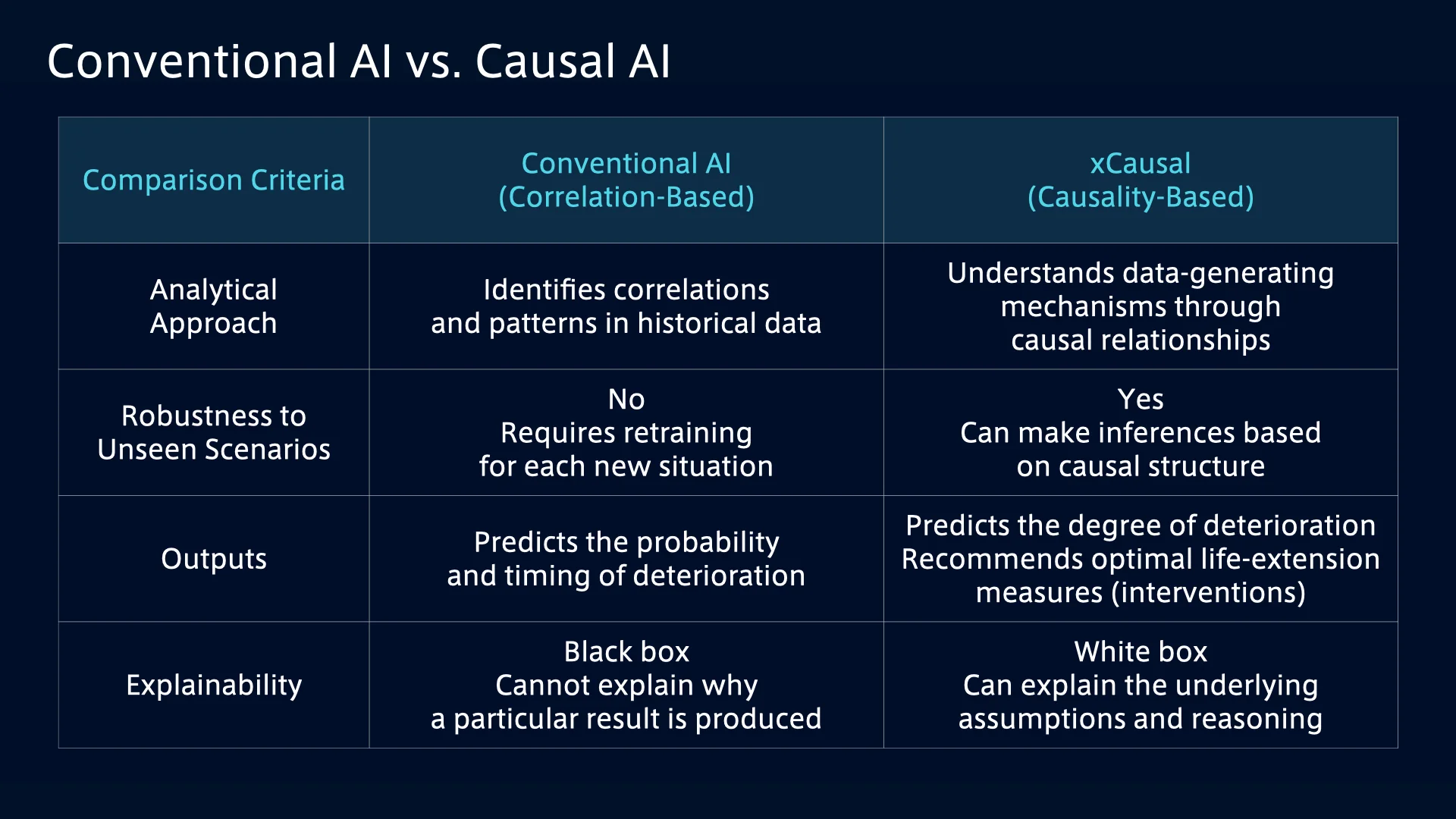
Conventional correlation-based AI learns patterns and relationships from historical data and predicts outcomes such as, “This asset is likely to deteriorate.” But it is not well suited to situations that fall outside historical patterns. This is a particular limitation for social infrastructure, where environmental conditions and human activities vary widely from one location to another. Even when a prediction can be made, conventional AI often cannot explain why a particular result was produced, because the underlying process remains a black box. Since social infrastructure is largely funded by public resources, on-site decision-making requires more than prediction alone. It must also answer questions such as:
“Why is this asset at high risk?”
“Which factors should we change to reduce the risk?”
“Which of several possible measures should we prioritize?”
“How much would the outcome change if we took action?”
■ xCausal® Turns Cause and Effect into the Next Best Action
xCausal® goes beyond predicting deterioration or failure. It analyzes “why an outcome occurs” and “which action can reduce risk, and by how much,” providing the evidence needed to select the right measures.
By combining domain expertise from the field with data, xCausal® models the causal relationships among asset conditions, environmental factors, operations, deterioration, past maintenance, and interventions as causal models. By making the links between causes and outcomes explicit, it supports analysis and decision-making based on model assumptions and available data.
Identify Risk Factors: visualize the factors driving risk and the causal pathways through which they affect risk
Evaluate the Effectiveness of Measures: compare outcomes with and without an intervention to estimate the expected reduction in risk
Compare Measures Under Different Conditions: estimate which measures are effective, and to what extent, depending on the conditions of each asset or location
Prioritize Inspections and Repairs: determine which assets and measures should be prioritized based on expected impact, cost, and operational constraints
xCausal® transforms the question “Where is the risk?” into the decision “Where should we act, and what should we do?” It supports effective, evidence-based maintenance even when budgets and human resources are limited.
■ From Predictive AI to AI That Supports Decision-Making
One of the core technologies behind xCausal® is the Structural Causal Model (SCM). SCMs explicitly represent causal structures among variables and enable reasoning about interventions and counterfactuals—questions that are difficult to address through correlation-based analysis alone. This makes What-If analysis possible, such as “What would happen if we cleaned this sewer?” or “What would happen if we changed the repair method?”
■ Capturing Complex Corrosion Mechanisms to Prioritize Inspections and Repairs
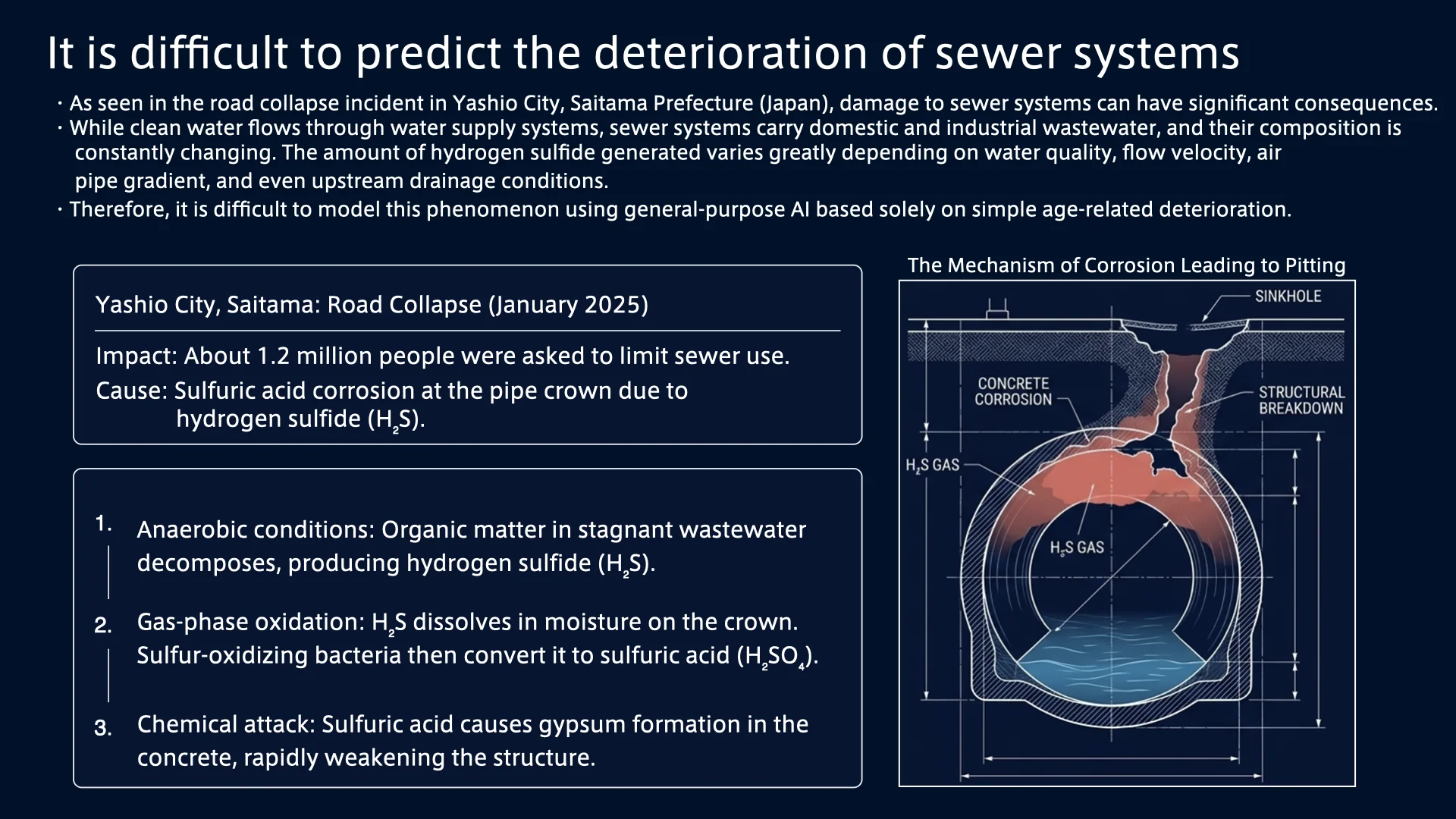
In sewerage systems carrying domestic and industrial wastewater, water quality and chemical composition are constantly changing. The generation of hydrogen sulfide, a major factor in corrosion, can also vary significantly depending on conditions such as wastewater retention, flow velocity, temperature, gradient, and upstream discharge characteristics. This makes corrosion difficult to predict using a simple age-based deterioration model.
■ Modeling Corrosion Mechanisms as Causal Models
xCausal® models the causal relationships among various factors, such as sewer structure, upstream discharge characteristics, topography, weather, flow conditions, environmental conditions, and maintenance history. This makes it possible to understand not only the deterioration risk of each sewer section, but also the factors creating that risk and the pathways through which they affect it.
■ Estimating Effective Measures and Intervention Effects
xCausal® helps determine which measures—such as cleaning, repair, or rehabilitation—are most effective at each location.
Even when two locations have the same level of deterioration risk, the most effective response may differ if the underlying causes are different. xCausal® compares outcomes with and without an intervention to estimate the causal effect of each measure for each sewer section.
• Narrow down sewer sections that should be inspected first
• Compare candidate measures such as cleaning, repair, and rehabilitation
• Determine implementation priorities based on expected impact and cost
■ Finding More Anomalies with a Limited Inspection Budget
For sewer sections that have been inspected in the past, records show whether actual damage was found. To evaluate the model, those results can temporarily be hidden, and a causal model built from historical data can be used to rank inspection priorities. We can then assess how many actual anomalies would have been found by inspecting locations from the top of the ranking.
For example, a model can be built using data up to two fiscal years ago and then used to predict the inspection results from the previous fiscal year. This makes it possible to reproduce how the system would have performed if it had been deployed at that time. By comparing the results with the current selection method, reductions in unproductive inspections and improvements in anomaly detection rates can be evaluated quantitatively.
A PoC can begin with this type of validation using historical data, then evolve into an operational system with continuous data acquisition, model improvement, and an interactive user interface.
■ From Analysis to AI That Works in the Field
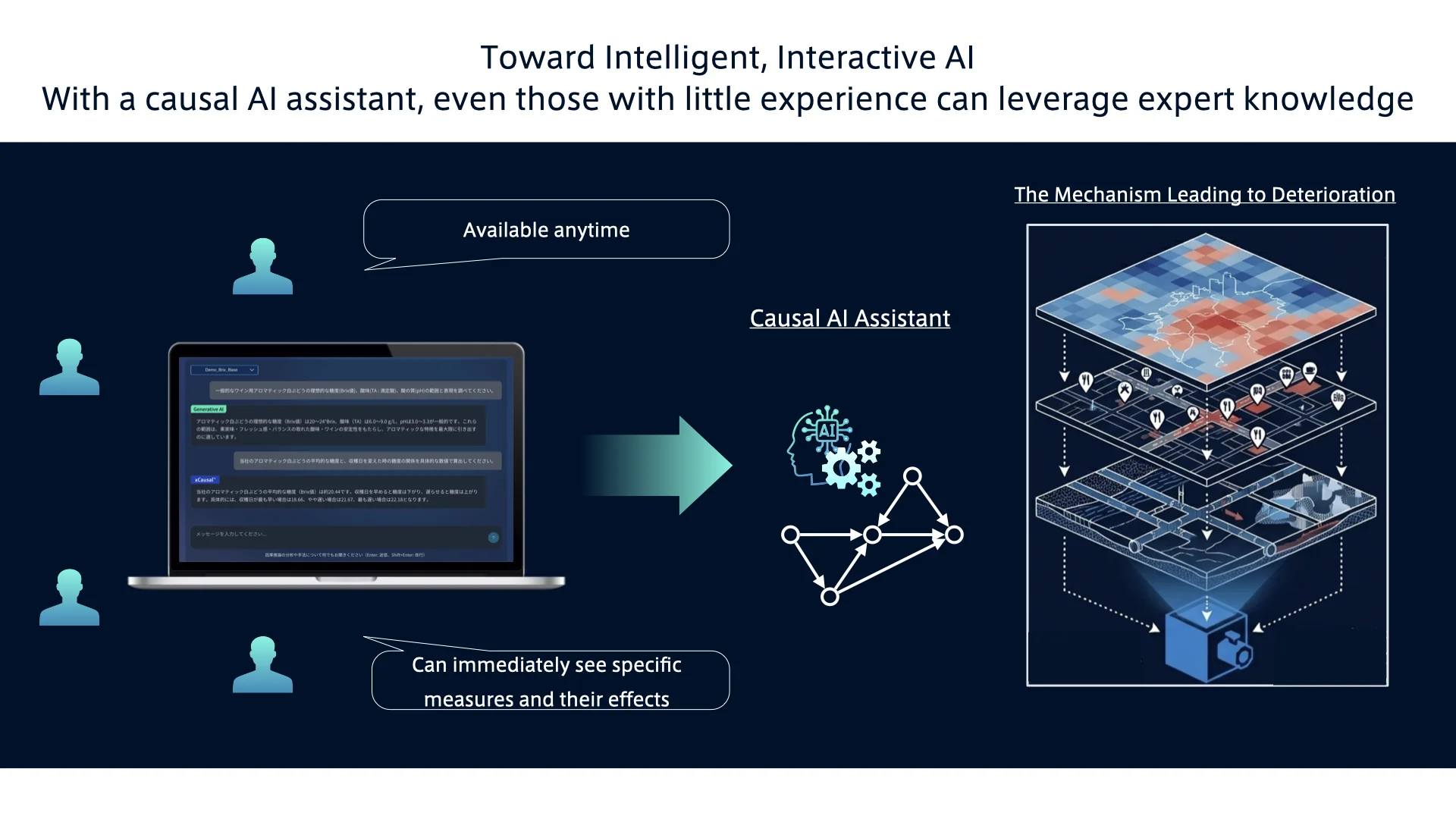
The Causal AI Assistant connects causal models with natural-language interaction in the field.
The Causal AI Assistant is an innovative custom solution that combines the strengths of Causal AI, Generative AI, and AI Agents. It captures expert knowledge and decision-making logic in the form of causal models and provides evidence-based answers to users’ questions.
“Which measure should we prioritize for sewer section A?”
“How much could a repair reduce the risk?”
“With this year’s budget, where should we inspect first?”
By integrating map data, asset registers, and inspection histories, organizations can build an intuitive system for reviewing risk, its causes, and recommended actions. As new data and human judgment are incorporated, the model can continue to improve, transforming expertise that once depended on individuals into shared organizational knowledge.
■ Directing Limited Budgets Toward Higher-Impact Inspections and Measures
Because xCausal® makes the reasons behind its outputs understandable, organizations can explain both their priorities and how budgets are allocated.
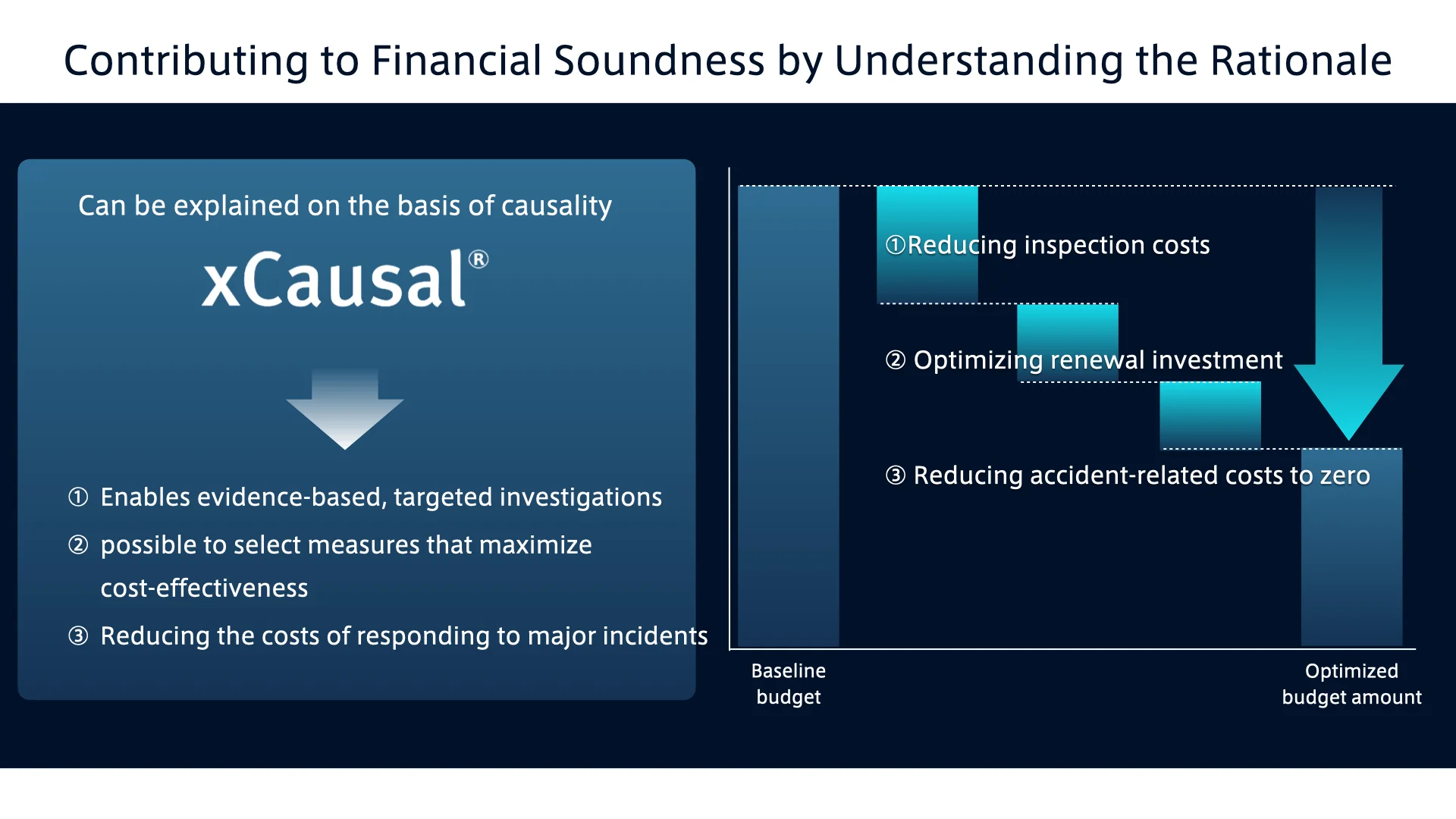
⬤︎ Reducing Inspection Costs
Inspection targets can be narrowed down based on the likelihood of damage and the evidence behind the decision, reducing inspections that yield no findings.
⬤︎ Optimizing Renewal Investment
By comparing asset-level risks with the expected effects of different measures, limited budgets can be allocated to the actions expected to deliver the greatest impact.
⬤︎ Reducing Incident Response Costs Through Preventive Maintenance
By identifying deterioration factors early and intervening at the right time, xCausal® helps extend asset life and reduce the risk of major incidents.
■ From Experience-Based Judgment to Evidence-Based Decisions That Can Be Shared
The approach is applicable across sewerage and other infrastructure. VELDT’s approach of using causal mechanisms extends beyond sewerage systems to roads, bridges, water supply, power infrastructure, railways, public facilities, disaster prevention, and other areas. In domains where assets, environmental conditions, operations, and human judgment interact in complex ways, xCausal® supports understanding causes, estimating the effects of measures, and setting priorities.