
What is the “Causal AI Assistant”?
An AI Assistant that Inherits and Evolves Expert Knowledge
— An Innovative Approach to Leveraging Organizational Knowledge and Addressing Talent Shortages —
■ Japan's Growing Knowledge Succession Challenge
According to Japan's Ministry of Internal Affairs and Communications, the country's working-age population (ages 15–64) is expected to decrease to 52.75 million by 2050—a roughly 30% drop from 2021. This demographic decline, coupled with labor shortages, poses severe risks for the transmission of skills and expertise, especially in manufacturing and research-intensive industries. More than half of Japanese manufacturing companies cite knowledge transfer as a key management challenge, with the loss of tacit knowledge resulting from the retirement of experienced workers threatening operational and innovation capabilities.
■ Can Generative AI Capture Expert Knowledge?
As AI continues to evolve, organizations are rapidly digitizing and leveraging the knowledge accumulated within their businesses. In particular, generative AI has attracted significant attention for its ability to improve information retrieval and content creation.
But can generative AI truly become a repository for the know-how of experienced professionals and highly skilled experts?
Generative AI generates responses based on pre-trained foundation models and learned patterns. It cannot answer questions about knowledge it has not learned, and because it predicts the most probable response, it may sometimes generate answers that sound plausible but are incorrect.
Highly skilled professionals, on the other hand, do not make decisions by memorizing countless patterns and selecting the most probable one. Instead, they rely on their understanding of cause-and-effect relationships. This enables them to make sound decisions even in situations they have never encountered before, including those for which no historical data exists.
■ Expert Know-How is Built on Understanding Cause-and-Effect Relationships
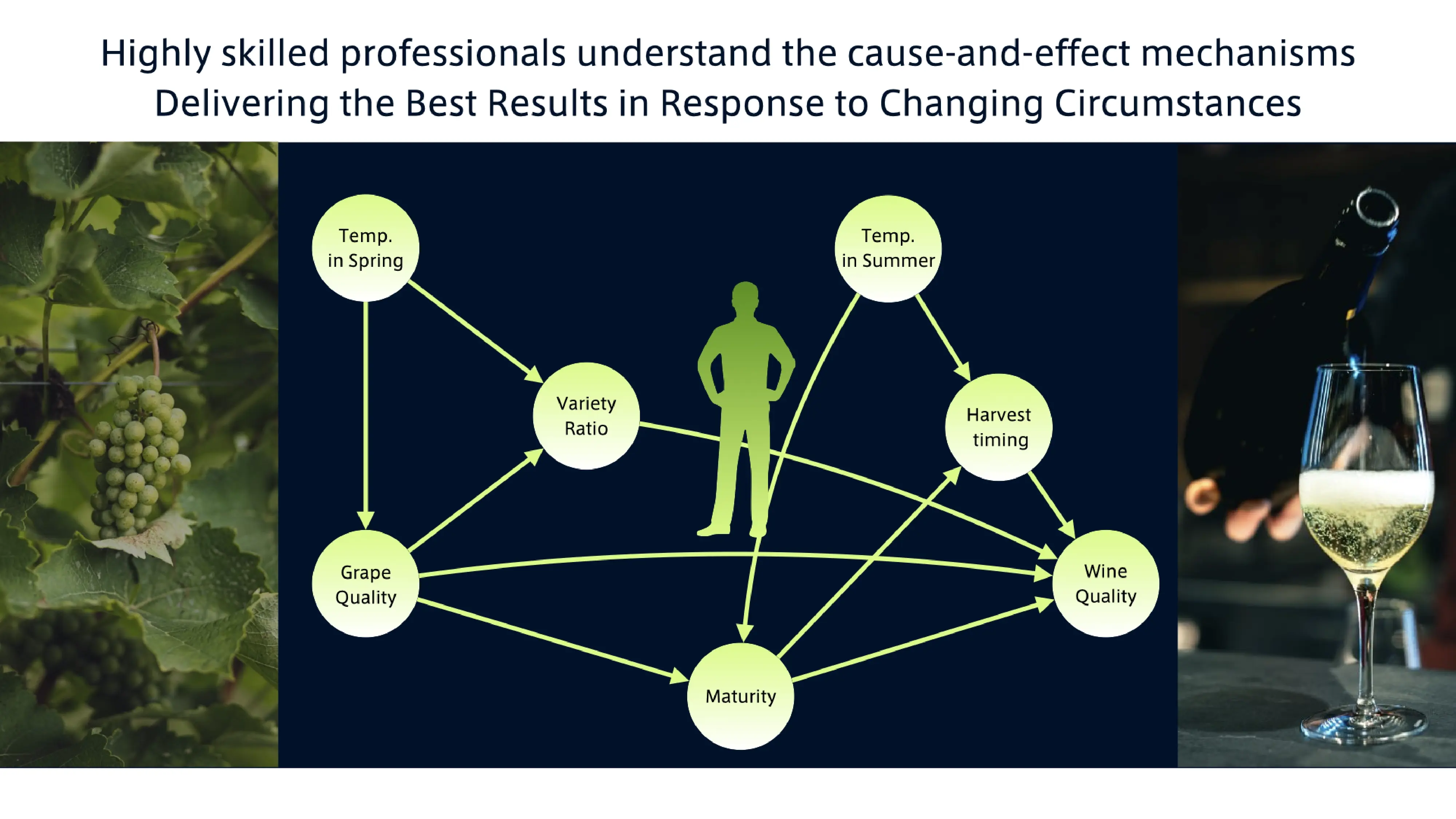
Consider, for example, a highly skilled professional responsible for producing sparkling wine. Climate has a major impact on grapes. In one year, a cold spring caused frost damage, affecting the grapes, while an extremely hot summer accelerated their ripening. In response, the winemaker took various measures, such as changing the blend ratio of grape varieties and moving the harvest date significantly earlier, ultimately shipping an excellent sparkling wine.
In another year, however, the climate was stable, and taking no special measures led to a good wine.
This kind of situational judgment is possible because experts implicitly understand complex cause-and-effect relationships, including what actions will lead to what outcomes.
These causal mechanisms can be represented as models.
■ Solution: Turning Causal Models into “Digital Experts”
Our solution is to model the causal mechanisms understood by experienced professionals and highly skilled experts, and implement them as AI systems that anyone can use.
This modeling is based on Structural Causal Models (SCMs), a well-established framework for causal inference. Although the underlying technology is sophisticated, our platform makes it easy to build and use causal models through an intuitive interface and natural-language interaction powered by generative AI.
The result is a Digital Expert—an AI that delivers the same kind of guidance you would receive from a seasoned professional. It can explain why a particular outcome occurs and recommend appropriate actions for a given situation, with both explainability and reproducibility. In effect, organizations can embed a Digital Expert that captures and scales expert knowledge across the enterprise.
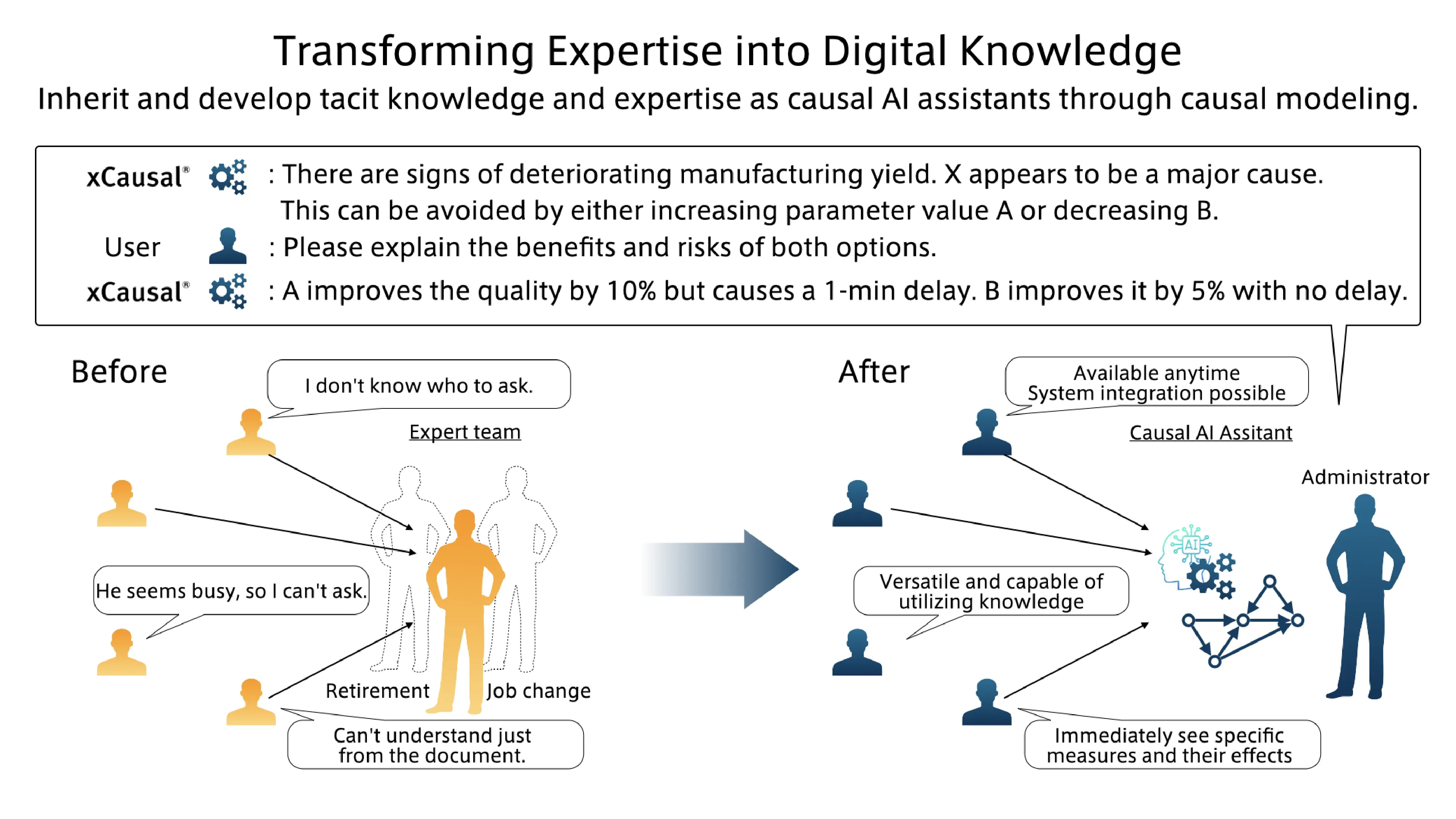
Transforming Expertise into Digital Knowledge
Inherit and develop tacit knowledge and expertise as causal AI assistants through causal modeling.
■ “Causal AI Assistant”: AI That Inherits and Evolves Expertise
Our Causal AI Assistant is an innovative custom solution that combines the strengths of Causal AI (also known as Causal Inference AI), Generative AI, and AI Agents. It enables everyone in an organization to access and apply expert knowledge, tacit know-how, and decision-making logic with both explainability and reproducibility.
Unlike conventional analytics tools that explore and infer causal relationships as one-off analyses, the Causal AI Assistant continuously evolves by incorporating new data and human expertise. As it learns and grows, it preserves organizational knowledge and increases its value as a long-term strategic asset.
■ Causal AI Assistant: Three Core Functions and Professional Services
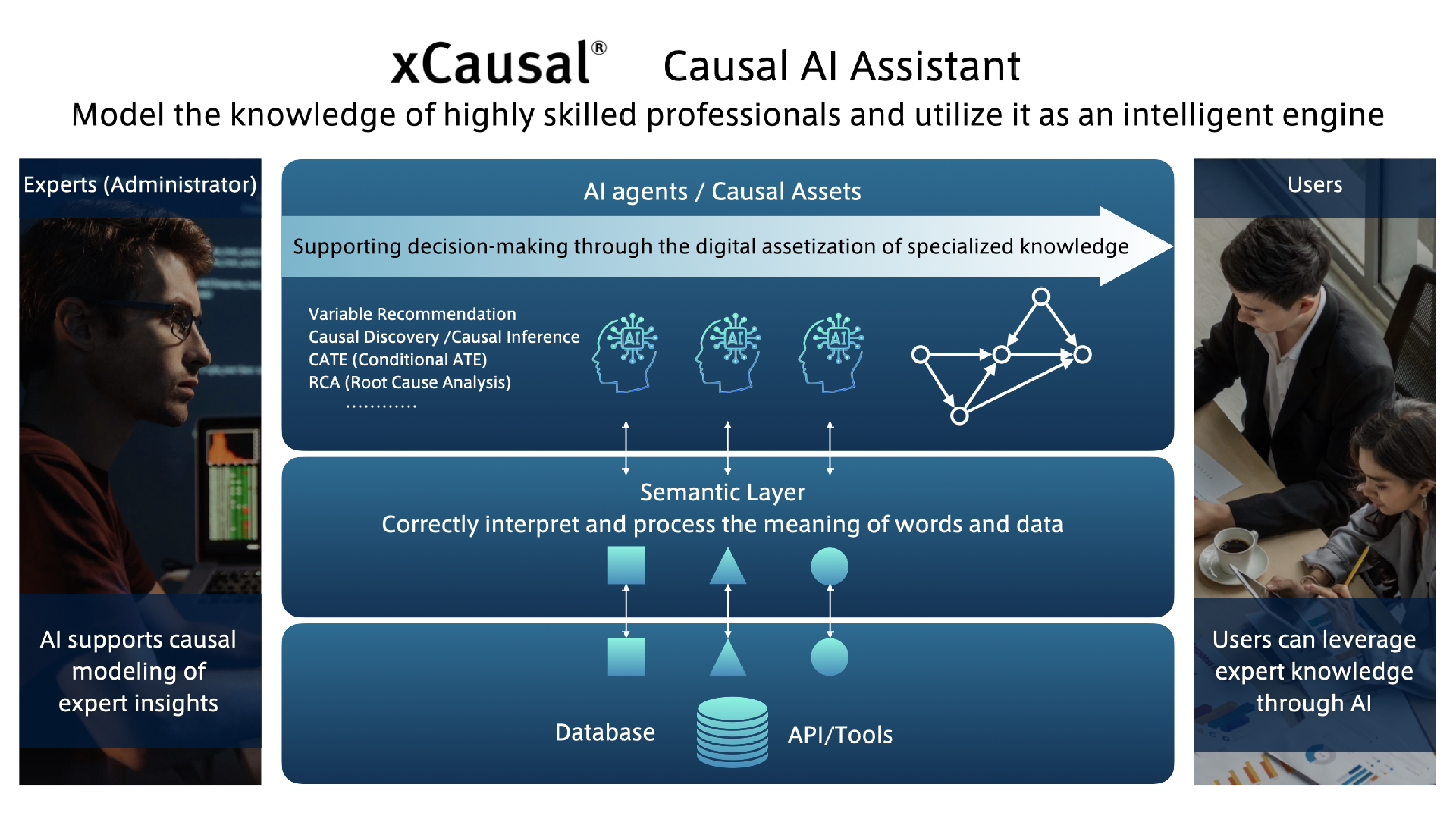
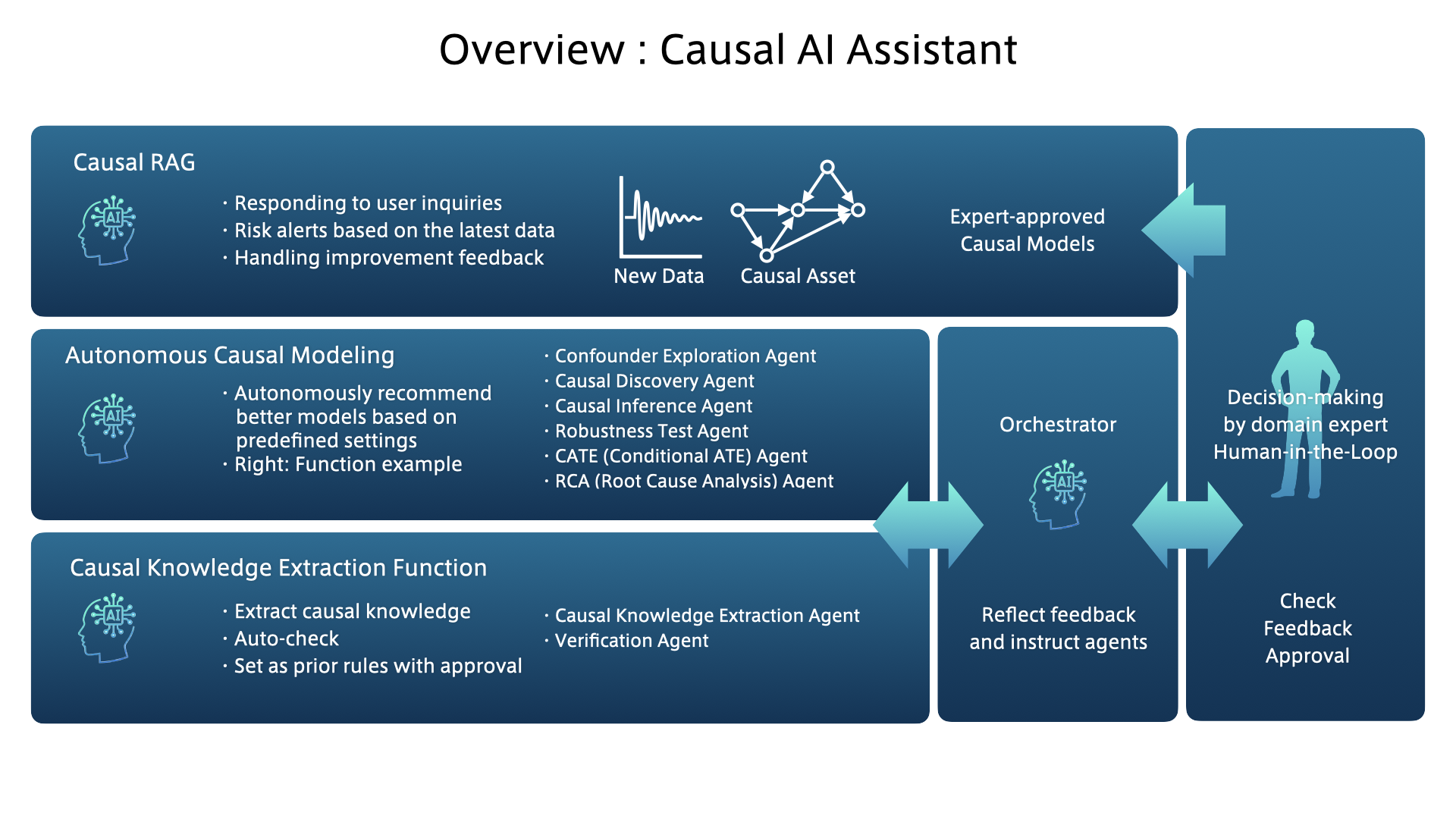
The Causal AI Assistant autonomously discovers, refines, and applies causal models through the collaboration of multiple AI agents. It captures known causal relationships from expert knowledge, uncovers previously unknown connections through robustness evaluation and variable exploration, and presents highly reliable models to administrators for review. The system then learns from human feedback to continuously improve its performance. This Human-in-the-Loop design enables the causal models to evolve and become increasingly accurate over time. To support successful implementation, VELDT also provides a range of professional services that analyze and structure causal knowledge obtained from experts.
1. Causal Knowledge Extraction Agents
Known causal relationships can be automatically extracted from text sources such as manuals and operational materials, and incorporated into the model as predefined rules. In addition to causal insights obtained directly from experts, the system can also incorporate systematically established knowledge from reliable sources. Application of these causal rules to the model is carried out under the supervision and validation of domain experts.
2. Autonomous Causal Modeling Agents
This group of agents operates autonomously under the coordination of an orchestrator agent, which manages and integrates multiple causal inference agents. In addition to utilizing known causal models, the system identifies and supplements highly probable unknown causal relationships and confounding factors based on robustness evaluation results. Depending on user needs, it can also present analytical outputs such as CATE (Conditional Average Treatment Effect) and RCA (Root Cause Analysis), while autonomously engaging in iterative hypothesis testing and model refinement through interactive feedback with administrators. By automating tasks that traditionally required manual trial and error—such as discovering, verifying, and updating causal relationships—these agents enable causal models to be built and refined with unprecedented speed and precision.
3. Causal RAG (Retrieval-Augmented Generation)
Utilizing approved causal models—referred to internally as “Causal Assets”—the system provides evidence-based answers and counterfactual scenario simulations through an interactive user interface. This allows general users to instantly gain causal insights, as if they were consulting directly with a domain expert. Furthermore, the system will continuously monitor connected external and real-time data, automatically detecting changes reflected in the causal models. As a result, it can autonomously identify early signs of risk and proactively recommend countermeasures or improvement opportunities.
■ Semantic Layer Integration Services
For AI agents to be used effectively in operational and decision-making environments, advanced reasoning capabilities alone are not sufficient. AI must also correctly understand the meaning of the words and data used by people and organizations. In real-world business settings, the same terms may carry different meanings across departments or roles, and data fields often contain implicit assumptions or contextual nuances. Even when database codes or column names are identical, their interpretations can vary significantly by organization or use case. If AI systems process such data via SQL or other mechanisms without understanding these semantic differences, they risk producing results that diverge from business intent.
Through its Semantic Layer Integration Services, VELDT structures organization-specific terminology, business context, and data definitions, linking coded data to its underlying business meaning. This enables AI agents to operate based on a shared semantic understanding, ensuring consistent reasoning and decision-making across the organization. By combining causal reasoning with semantic understanding, AI agents can perform processing that is reproducible, consistent, and aligned with organizational assumptions, forming a reliable foundation for trustworthy AI-driven operations.
■ Expected Benefits
● Knowledge Succession and De-Personalization
By capturing the decision-making processes of veteran professionals and experts as causal models, organizations can preserve and develop expertise that is no longer dependent on individual personnel—ensuring continuity beyond retirements or transfers. This enables a wider range of employees to leverage the know-how of highly skilled experts, while evolving it into shared organizational intelligence. As a result, companies can achieve reproducibility and consistency in complex tasks such as development, troubleshooting, and operational decision-making.
● Explainable Decision-Making
The system visualizes “why” a particular conclusion was reached through a causal relationship model—referred to as a Causal Asset—which clearly illustrates the underlying assumptions and causal pathways behind each outcome. This enables both management and on-site personnel to explain the basis of their decisions to third parties, enhancing transparency and credibility both inside and outside the organization. Moreover, by quantifying the causal effects of actions with concrete numerical indicators, the system accelerates problem-solving, investment prioritization, and decision-making.
● Enhanced Synergy with Generative AI
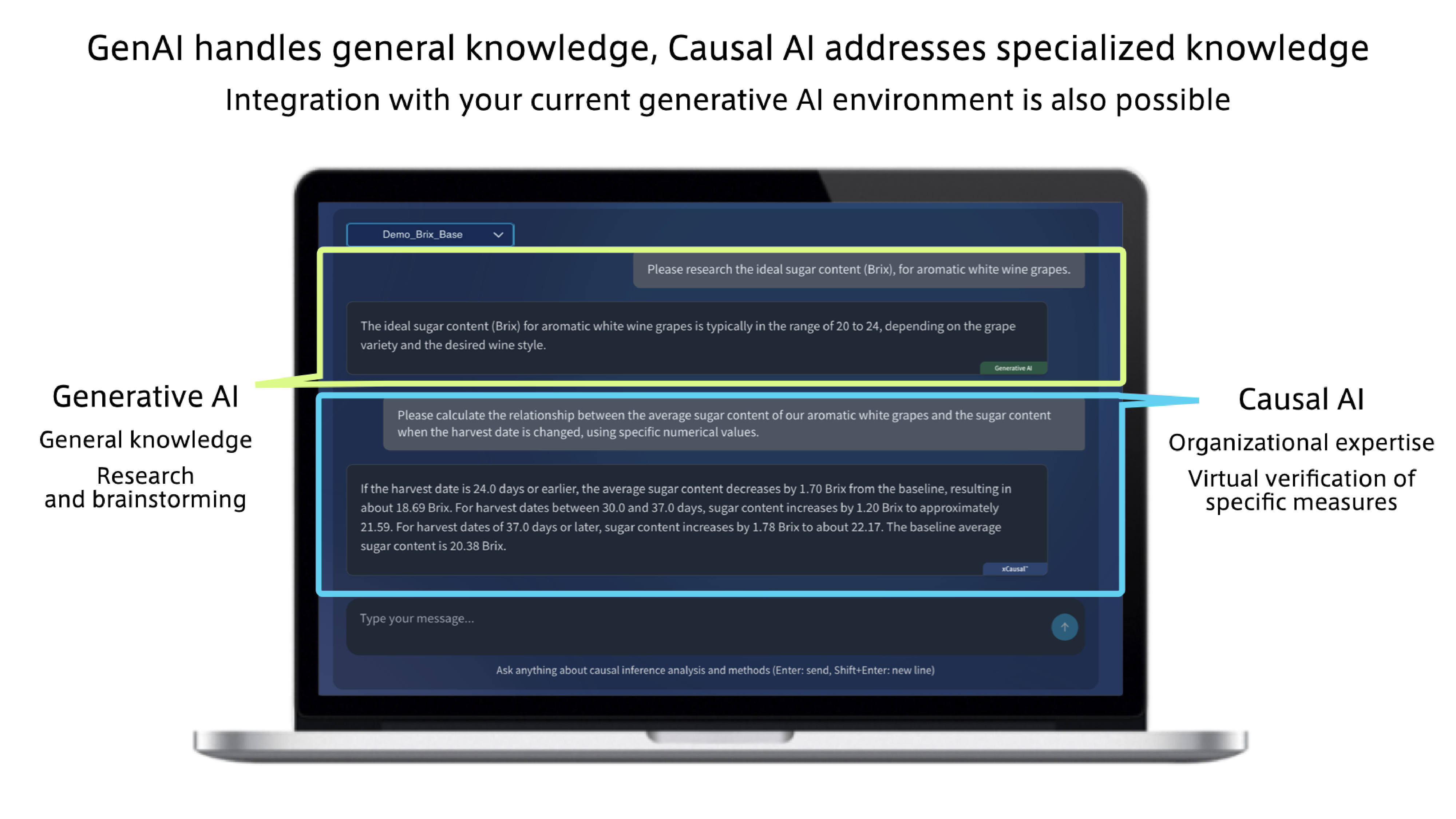
Because the Causal AI Assistant retains both the organization's own experiential knowledge and highly reliable domain-specific insights, it can work in tandem with generative AI—leveraging its strength in broad knowledge exploration and idea generation—to simulate concrete, organization-specific strategies. This enables evidence-based reasoning in intellectual tasks such as business planning and problem-solving, improving both the quality and efficiency of knowledge-driven work while increasing the overall value of AI utilization across the enterprise.
● Intelligent Engine for IT Services
By integrating the Causal AI Assistant with real-time data updates, organizations can perform risk detection and deliver personalized recommendations based on cause-and-effect relationships. Through integration with a wide range of IT services—including healthcare, manufacturing, finance, and logistics—the system can provide unprecedented added value and new forms of intelligence across industries.