―Addressing Data Scarcity in AI Development and Statistical Analysis Through Causal Mechanisms―
Launch of the "xCausal® Data Augmentation" Feature, Which Generates Large-Scale Augmented Data from Seed Data
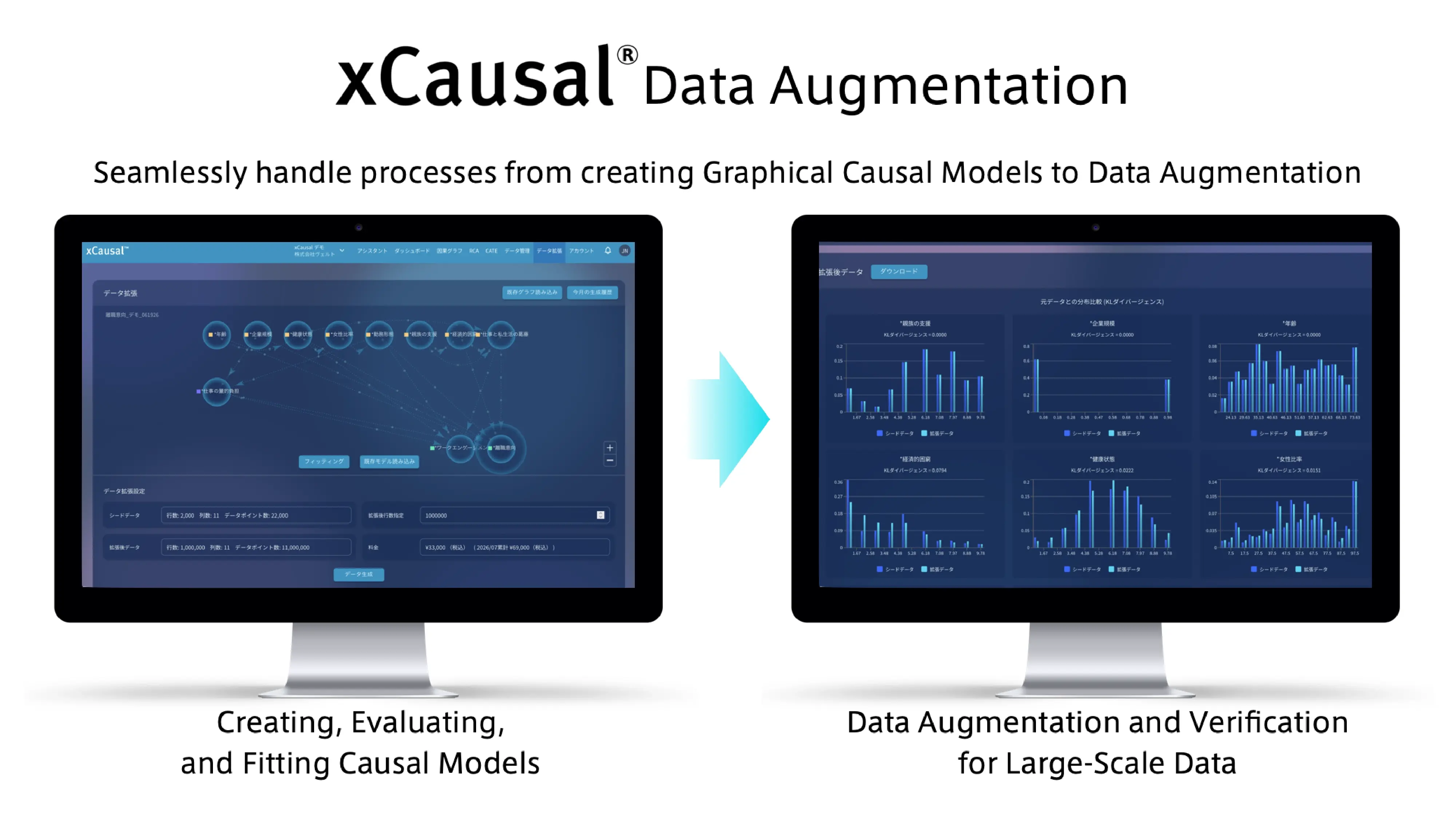
VELDT Inc. (Headquarters: Shibuya, Tokyo; CEO: Jin Nonogami, hereafter "VELDT") today announced that it will launch xCausal® Data Augmentation, a new capability of its proprietary causal AI platform xCausal®, on July 13. The new capability generates large-scale datasets for AI development and statistical analysis from a small amount of seed data.
This feature leverages the ability of a Graphical Causal Model (GCM) to scale a small amount of seed data into a large-scale dataset when the GCM accurately captures the reality of the target domain. It addresses real-world needs in settings where "there are many variables but few cases," such as rare disease research in healthcare, and can be applied to fields facing severe data shortages, including manufacturing, finance, infrastructure, and mobility. A built-in Fidelity verification feature allows users to quantitatively assess the similarity between the generated data and the seed data.
Beginning in 2026, VELDT has adopted a new mission statement:
"We power your business with WHY — Redefining trust in the age of AI."
As part of its initiative to put this concept into practice, VELDT is introducing this capability, which is centered on the cause-and-effect mechanism—the "why" behind outcomes.
■ Background: Addressing the Structural Challenge of Data Scarcity Across Industries
A shortage of data for specific events and scenarios remains a common challenge in AI development and statistical analysis. The events that matter most for decision-making—such as defective products, fraudulent transactions, equipment failures, natural disasters, and rare diseases—are often the least frequently observed. As a result, datasets are inherently imbalanced, making it difficult for predictive models to accurately learn and identify these critical cases.
While generative AI-based synthetic data technologies have advanced rapidly in recent years, most state-of-the-art approaches require large volumes of training data to achieve high performance. Consequently, they are often least effective in data-scarce environments. When trained on limited data, these models tend to produce variations of the original samples rather than meaningful new observations. Furthermore, because the generation process is largely a black box, their adoption remains challenging in highly regulated industries such as healthcare and financial services, where explainability and accountability are essential.
■ Using the Graphical Causal Model as the Data Generation Mechanism
Common data generation methods, such as Generative Adversarial Networks (GANs) and Variational Autoencoders (VAEs), rely on large amounts of training data and generate new samples by learning the observed statistical distribution. Because they do not capture the underlying reasons why values take the forms they do, their accuracy decreases when only limited reference data is available, and the generation process itself is difficult to explain.
In contrast, a Graphical Causal Model (GCM) serves as a blueprint for data generation by representing the chain of cause-and-effect relationships through which data is produced. For example, it can encode such causal relationships as, "when one condition changes, it causes the next state to change, as a result affecting product quality," which enables the generation of large amounts of plausible data even from a small amount of seed data. It also makes it possible to explain why each individual value is generated.
Unlike imitative approaches, a GCM can generate plausible data by following its causal blueprint even for conditions that have not actually been observed—for example, what would happen if a particular factor were changed?
■ Key Features
1. Data Augmentation Based on Causal Structure Rather Than Correlation
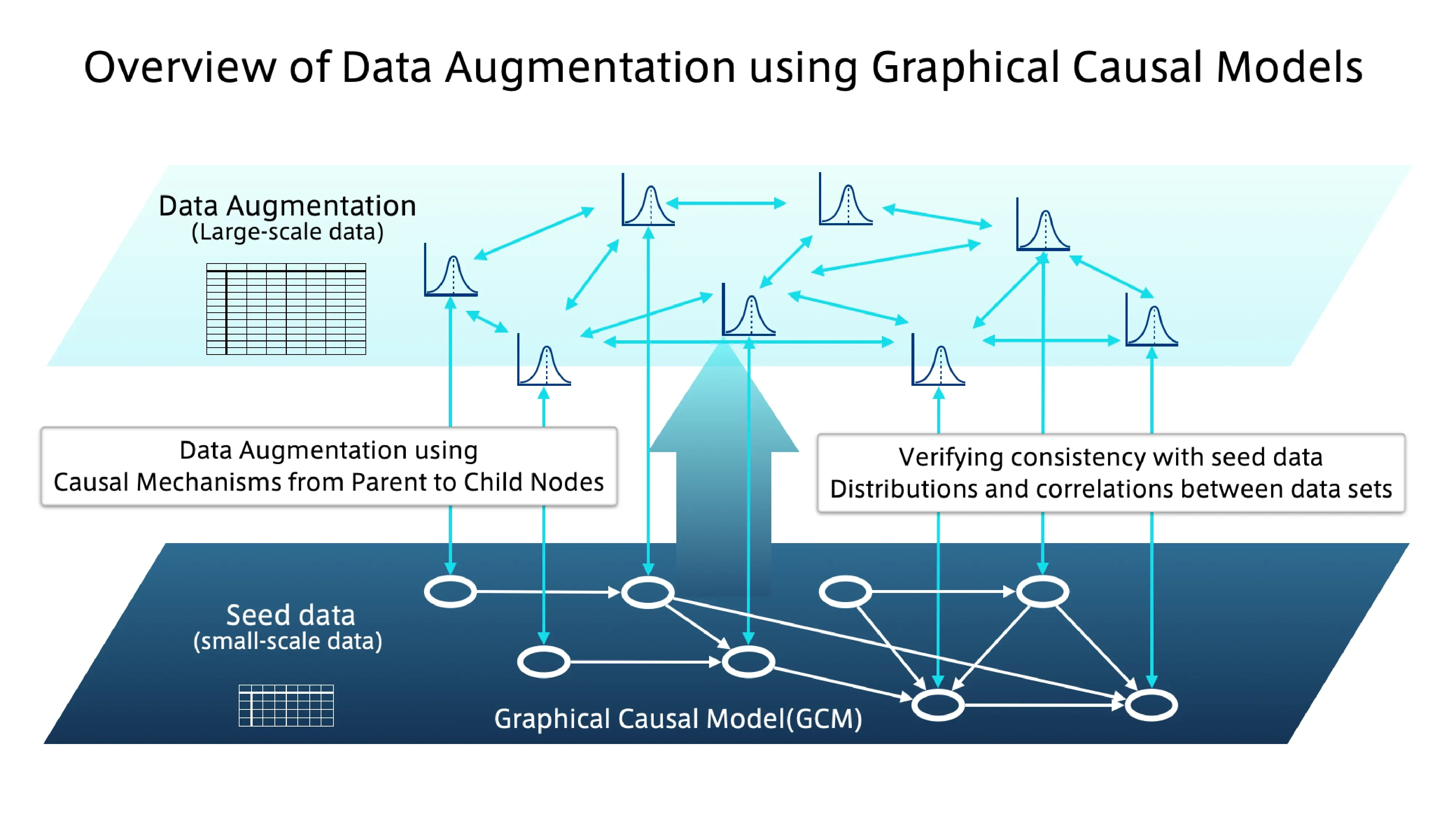
The capability augments data using the following data generation mechanism. Whereas conventional methods generate data by reproducing statistical correlations in the observed data, this approach generates data based on causal structure. As a result, it remains effective even with a small amount of seed data and can explain why each data point was generated based on the underlying causal structure. It can also generate intervention and counterfactual scenarios that have not been observed but are causally plausible, making it well-suited for rare-event analysis and stress testing.
Variables without parent nodes (root nodes) are sampled from their probability distributions.
Variables with parent nodes (child nodes) are calculated by applying a function or machine learning model to the values of their parent nodes, with noise added to determine the final value. This functional mechanism can be expressed as:
Child = f(Parent) + Noise
This process is repeated sequentially from upstream (parent nodes) to downstream (child nodes), generating one data record at a time. By repeating the process as many times as required, the capability can generate a large-scale dataset while preserving the same causal structure as the seed data.
2. Fidelity Validation
The capability quantitatively evaluates how faithfully the generated synthetic data reproduces the statistical characteristics of the seed data from the following two perspectives:
Similarity of the distribution of each variable: compares the univariate distribution of each variable with that of the seed data.
Preservation of relationships between variables: compares whether the correlations and dependency relationships among variables are preserved.
For users requiring a higher level of validation, VELDT also offers Utility validation as a professional service. The same predictive model is built and evaluated using both the seed data and the generated synthetic data to assess the quality of the synthetic data from the perspective of whether it can serve as a substitute for real-world data.
* The concepts of synthetic data and Fidelity evaluation used in this capability are based on the definitions and evaluation methodology for synthetic data published by the UK Office for National Statistics (ONS).
3. Reliability and Ease of Use of the xCausal® Causal AI Platform
This capability is powered by xCausal®, VELDT's causal AI platform. xCausal® is an intuitive SaaS-based causal AI platform that requires no coding. It enables users to rapidly build reliable causal models based on the well-established framework of Structural Causal Models (SCMs), complemented by robustness evaluation capabilities.
4. Professional Services: Support for Graphical Causal Model Development and Utility Validation
VELDT provides end-to-end professional services, from supporting the development of the Graphical Causal Model (GCM) required for this capability to validating the utility of the generated synthetic data. VELDT supports causal model development by identifying the variables and data required for modeling, including covariates, and by assisting in the design and implementation of the causal model. Utility validation assesses whether synthetic data can serve as a substitute for real-world data by comparing the performance of predictive models trained on the seed data and the generated synthetic data.
■ Assumptions and Scope
This capability is designed to operate effectively on the assumption that the underlying Graphical Causal Model (GCM) and its causal mechanisms are valid from a domain expert's perspective.
Usage Assumptions: If the underlying GCM does not accurately represent the real-world domain, the generated data may also be inaccurate. Because the quality of the generated data depends on the validity of the input GCM, users are advised to have the causal structure reviewed and validated by domain experts before using this capability.
Supported data: This capability is intended for tabular numerical data.
Data balance: The quality of the generated data is also influenced by the balance of variables in the seed data. If the seed data is highly imbalanced, the generated data will reflect those same characteristics.
■ Contributing to AI-Ready Data
In recent years, the importance of AI-ready data—data prepared for immediate use in AI training and inference—has grown rapidly in public policy initiatives in Japan and around the world. AI-ready data is not simply data in large volumes; it is high-quality data that ensures accuracy, consistency, and completeness while enabling AI systems to correctly interpret its meaning. Large volumes of such high-quality data are essential for improving AI performance while reducing hallucinations and bias.
Japan's first Basic Plan for Artificial Intelligence, approved by the Cabinet on December 23, 2025, under the subtitle "Revitalizing Japan Through Trustworthy AI," identifies the development and expansion of high-quality data—one of Japan's strengths—as well as ensuring the explainability and transparency of AI as national priorities [1]. In addition, the Basic Policy on the Data Utilization Framework, adopted by the Digital Administrative and Fiscal Reform Council on June 13, 2025, promotes the creation of a virtuous cycle between data and AI, with the realization of an AI-powered society as one of its guiding principles [2].
The xCausal® Synthetic Data Augmentation capability addresses the challenge of scaling high-quality data by expanding a small amount of high-quality seed data into large-scale datasets based on causal structure. In addition, its built-in Fidelity validation enables users to quantitatively verify that the generated synthetic data preserves the accuracy and consistency of the original seed data. By improving both scale and quality, this capability supports the development of AI-ready data and accelerates AI adoption in data-scarce domains. In doing so, it also contributes to the virtuous cycle between data and AI envisioned by the Japanese government.
[1] Cabinet Office, Government of Japan. Basic Plan for Artificial Intelligence (approved by the Cabinet on December 23, 2025). Available at: https://www8.cao.go.jp/cstp/ai/ai_plan/aiplan_20251223.pdf
[2] Digital Administrative and Fiscal Reform Council. Basic Policy on the Data Utilization Framework (adopted on June 13, 2025, and approved by the Cabinet on the same day as part of the Priority Policy Program for the Realization of a Digital Society). Available at: https://www.cas.go.jp/jp/seisaku/digital_gyozaikaikaku/pdf/data_houshin_honbun.pdf
■ Target Industries and Representative Use Cases
The capability is intended for a wide range of industries where data scarcity and data imbalance present significant challenges, including healthcare and drug discovery, financial services and insurance, physical AI and mobility, social infrastructure and disaster prevention, manufacturing and cybersecurity. Representative use cases include:
Pharmaceuticals: Generation of Synthetic External Control Arms (ECAs)
Generate counterfactual patient data from a limited number of patient records to construct synthetic external control arms for clinical trials.
Financial Services: Resilience Testing for Emerging Anti-Money Laundering (AML) Schemes
Generate previously unobserved money laundering and fraud patterns based on causal graphs to identify blind spots in AML detection models.
Physical AI: Generation of Physically Consistent Edge Cases
Generate physically valid accident and failure scenarios from limited measurement data by enforcing physical constraints, enabling the safe creation of large-scale edge-case datasets for AI development and validation.
■ Comment from Professor Shogo Watanabe, Graduate School of Health Sciences, Okayama University
As AI-driven analysis continues to advance in cardiovascular medicine, ensuring the reliability of treatment decisions has remained a significant challenge. Conventional prediction methods based solely on correlations are often insufficient to reliably determine which therapeutic intervention is the most appropriate.
VELDT's causal inference technology addresses this challenge by constructing causal models from complex clinical data, enabling the simulation of optimal treatment effects even when only limited real-world data is available. I believe this approach will significantly improve the interpretability of medical AI and serve as an important model for advancing personalized medicine in cardiovascular care.
■ About VELDT Inc.
VELDT Inc. is a data science company that accelerates social problem-solving and Goodwill Innovation through the power of understanding "why." As a leading company in Causal AI (causal inference AI), VELDT provides the causal AI platform "xCausal®" that elucidates cause-and-effect relationships, and the custom solution "Causal AI Assistant" that transforms expert knowledge and advanced organizational decision-making processes into AI. By delivering "trustworthy AI" with interpretability and explainability to AI systems that tend to be black boxes, VELDT creates a positive spiral for society.
| CEO: | Jin Nonogami |
| Headquarters: | 5-18-10 2-D Jingumae, Shibuya-ku, Tokyo |
| Established: | August 1, 2012 |
| URL | https://veldt.jp/en/ |
■ Contact
VELDT Inc.
Media Relations: Haruka Tashiro
Phone: 03-6427-4457
E-mail: pr@veldt.jp